Dark Web
Think about the internet like a huge ocean. The part you normally use every day websites like Google, YouTube, and Instagram is like the surface of the water, where everything is visible and easy to access.But deep under the water, there are areas that normal people don’t see easily. These hidden sections are not listed on search engines and require special tools to reach. One of these hidden areas is called the Dark Web.
Simple Definition
The Dark Web is a part of the internet that cannot be accessed using normal search engines or regular browsers.It contains websites that are hidden from the public internet and usually require special networks or software to open.
Why Is It Called Dark?
Don't worry it doesn't mean the internet turns off the lights. It is called “Dark” because:
-
The websites are hidden.
-
They are not listed on search engines.
-
Normal users usually don’t see them.
So it’s not literally Dark just Invisible to Normal Internet Browsing.
A Small Story of a Student
Before we continue learning about the Dark Web, here is a short story that explains how curiosity about it can begin. There was a student in 6th grade who enjoyed watching technology and internet videos on YouTube. One day while watching different videos, he noticed that many creators were talking about something mysterious called the “Dark Web.” In many of those videos, people said things like:
-
“The Dark Web is very dangerous.”
-
“Hackers are there.”
-
“Normal people should stay away from it.”
Hearing these things again and again made the student very curious. Soon questions started coming into his mind:
-
“What actually is the Dark Web?”
-
“Is it really real, or is it just something people say in videos?”
Because of this curiosity, he slowly started trying to learn more about it. His intention was not bad he simply wanted to understand the truth behind the topic.
What the Student Did to Learn
The student began doing small research in his free time. For example, he would:
-
Watch more YouTube videos about the Dark Web.
-
Try to understand why people call it dangerous.
-
Search information online to understand what it actually is.
-
Talk with friends to see if anyone knew about it.
But the strange thing was that most people only talked about how scary it is, not what it really is or how it works. Some Friends said:
-
“Maybe it’s fake.”
-
“Maybe it’s very dangerous.”
But no one could clearly explain what the Dark Web actually is.
The Day of Discovery
Time passed, and the student eventually reached 9th grade. His curiosity about the Dark Web never disappeared. One day he finally decided that he wanted to understand it properly instead of just hearing stories about it. Among his friends and classmates, he was probably one of the first students who became curious enough to actually explore and learn about it, while many others had only heard stories. For him, that moment felt a little scary but also very exciting, because after years of curiosity he was finally going to learn what that mysterious part of the internet really is. And after all that curiosity and research, He finally reached the Dark Web.
All Web Vs Dark Web
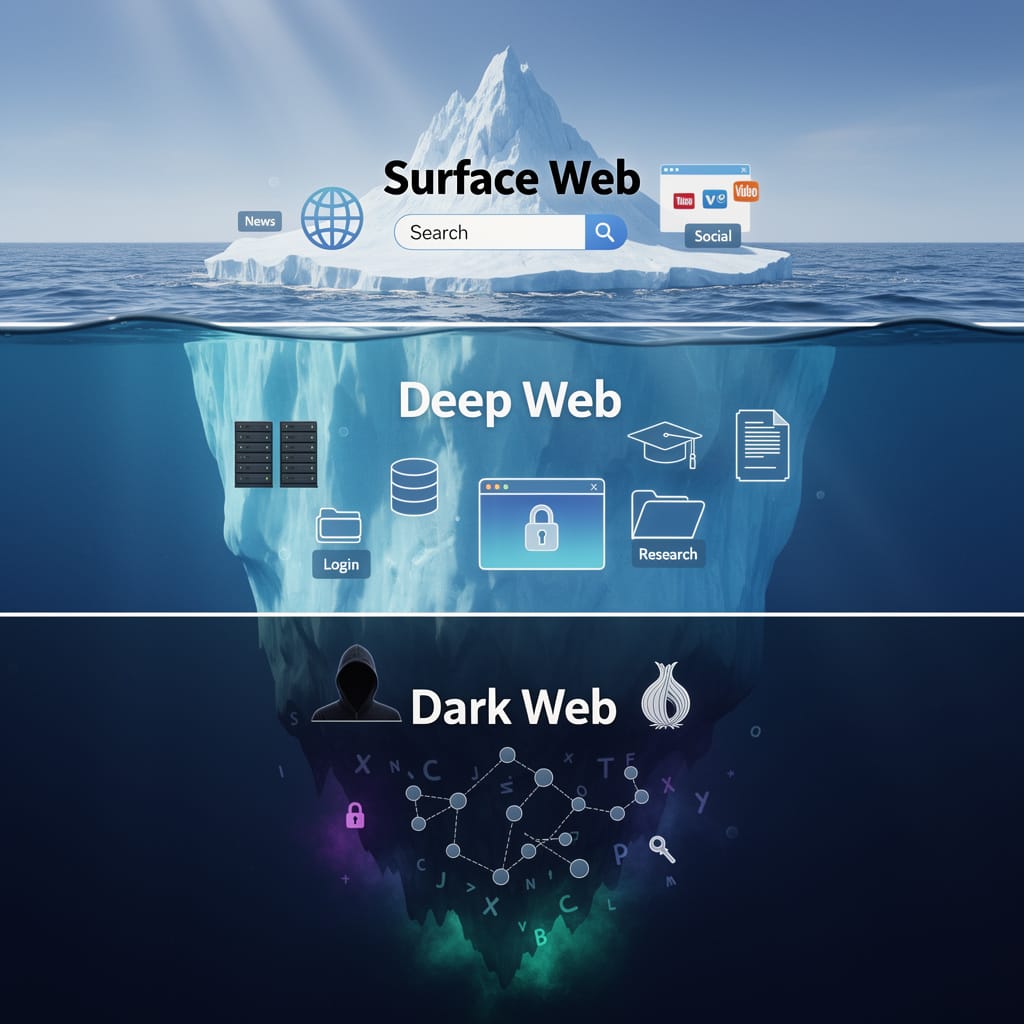
Surface Web
The Surface Web is the part of the internet that is publicly accessible and easy to use. It includes websites that anyone can visit using a normal web browser. When you search something on Google and open a website from the results, you are using the Surface Web. This part of the internet is indexed by search engines, which means websites are organized and can easily appear in search results.Most of the online activities people do every day happen on the Surface Web. For example, watching videos, reading blogs, using social media, shopping online, or reading news articles all take place on websites that belong to this visible layer of the internet. Because these websites are open to the public, they are designed to be easy to find and easy to navigate.Even though the Surface Web feels very large to most users, it actually represents only a small portion of the entire internet. Experts often estimate that it is only about 5–10% of all online content, while the majority of information exists deeper below the surface.
Key Points
-
Public websites accessible to everyone.
-
Indexed by search engines like Google and DuckDuckGo.
-
Accessible with normal browsers.
-
Includes social media, blogs, videos, and shopping websites.
Deep Web
The Deep Web refers to parts of the internet that are not indexed by search engines. This does not mean the content is illegal or dangerous. In fact, most of the Deep Web is made up of private and secure information that is meant to stay protected. These websites usually require a login, password, or special permission to access them.For example, when you check your email inbox, access your online banking account, log into a university portal, or view documents stored in cloud storage, you are accessing the Deep Web. These pages are not visible in search engine results because they are personal or restricted. Search engines cannot access them because they are protected by security systems.The Deep Web is actually the largest part of the internet, containing huge databases, academic records, private company information, government systems, and many other types of content that must remain secure. Without the Deep Web, many of the services people rely on daily would not be able to function safely.
Key Points
-
Not indexed by search engines.
-
Requires login or authorization.
-
Includes email accounts, banking portals, and private databases.
-
Mostly legal and secure content.
Dark Web
The Dark Web is a small section of the Deep Web that is intentionally hidden and requires special software or networks to access. Unlike the Surface Web, which can be opened using standard browsers, the Dark Web requires specialized tools that allow users to access websites anonymously.The main purpose of the Dark Web is privacy and anonymity. Some people use it to communicate securely, protect their identity, or avoid censorship in countries where internet access is restricted. Because of the anonymity it provides, journalists, activists, and privacy advocates sometimes rely on these networks to share information safely.However, due to the same anonymity features, the Dark Web can also host activities that are unsafe or illegal. For this reason, it is often discussed carefully and approached with caution. Despite its reputation, the Dark Web is actually a very small part of the internet compared to the Surface Web and Deep Web.
Key Points
-
Requires special software to access.
-
Focused on privacy and anonymity.
-
Used for secure communication and information sharing.
-
Represents a very small part of the internet.
The History of Dark Web
In the early days of the internet, security and privacy were very weak. Anyone who monitored the network could analyze traffic and sometimes discover who was communicating with whom. This created serious problems for governments, military operations, and intelligence agencies.Researchers began asking an important question:
-
Is it possible to use the internet without revealing who you are or where the communication is coming from?
To solve this problem, scientists at the United States Naval Research Laboratory (NRL) started developing a new system in the mid-1990s designed to hide the identity of internet users.The scientists behind this research included:
-
Paul Syverson
-
Michael G. Reed
-
David Goldschlag
Their goal was to create a technology that could protect U.S. intelligence communications from surveillance and traffic analysis.
The Creation of Onion Routing
The researchers developed a concept called Onion Routing. The idea was simple but powerful. Instead of sending data directly from one computer to another, the data would travel through multiple computers (called nodes) across the internet. At each step, the information would be encrypted in layers similar to the layers of an onion.Each computer in the chain would only know the previous and next location, but never the full path of the communication. This meant that tracking the original sender became extremely difficult. The technology was further developed with support from organizations like DARPA, and the research was published publicly in 1998, introducing the idea of anonymous internet connections. At this stage, the system was still mostly a research experiment and was mainly used for government and military purposes.
The Birth of Tor (The Onion Router)
In the Early 2000s, Researchers continued improving Onion Routing.Computer scientists Roger Dingledine and Nick Mathewson, working with Paul Syverson, helped transform the concept into a real working network called Tor, which stands for The Onion Router. The first version of Tor was released on September 20, 2002. Tor allowed internet users to browse anonymously by routing their connection through multiple volunteer-operated servers around the world.
Key Features
This System made it Extremely difficult to determine:
-
the User's real IP address
-
The origin of the communication
-
The location of the Server Hosting the Website
Opening Tor to the Public
At first, Tor was developed mainly for government and intelligence communication. However, there was a problem.If only intelligence agencies used Tor, then anyone using it would immediately look suspicious. To prevent this, the developers decided to release Tor as open-source software so that anyone could use it. In 2004, the code for Tor was publicly released, and organizations like the Electronic Frontier Foundation (EFF) helped fund its development. By 2006, a nonprofit organization called The Tor Project was created to manage and maintain the network. This decision changed everything. Now anyone journalists, activists, researchers, or ordinary users could browse the internet anonymously.
Structure of the Internet
The internet is not just one simple network. It is structured in different layers, where each layer contains different types of information and access levels. The top layer is the Surface Web, which includes public websites that anyone can easily visit using normal browsers and search engines. Beneath that is the Deep Web, which contains private or protected information such as databases, accounts, and systems that are not visible to search engines. Deeper within this structure exists the Dark Web, a small hidden section designed to provide strong anonymity and privacy through special networks and technologies.
Purpose of Creating Dark Web
The Dark Web was not originally created for crime or illegal activities. In fact, its creation was based on an important goal: protecting privacy and secure communication on the internet. In the early days of the internet, researchers and government organizations realized that online activities could be monitored, tracked, and analyzed. This meant that sensitive communication between people could easily be discovered. To solve this problem, scientists developed technologies that could hide the identity and location of internet users. These systems allowed information to travel through multiple encrypted connections so that it would become extremely difficult for anyone to trace who was sending or receiving the data. The goal was to create a safer way for people to communicate online without being constantly watched. Another reason behind the creation of these anonymous networks was freedom of information and protection from censorship. In some parts of the world, governments restrict internet access or monitor what people say online. Anonymous networks help journalists, researchers, and activists share information safely without revealing their identity. Over time, these privacy-focused technologies formed hidden networks where both users and websites could remain anonymous. This environment eventually became known as the Dark Web, a part of the internet designed mainly to provide privacy, anonymity, and secure communication.
Key Points
-
The Dark Web was created to protect privacy and Anonymity Online.
-
It helps hide the Identity and location of Internet Users.
-
It Allows Secure Communication Without easy Tracking.
-
It can help People Bypass Censorship and share information Safely.
Is the Dark Web Illegal?
Many people think that simply visiting the Dark Web is illegal. However, the reality is a little more complex. Accessing the Dark Web itself is not illegal in most countries. It is simply another part of the internet that requires special software to open, just like some networks require special apps or permissions. The important thing to understand is the difference between access and activity. Opening the Dark Web or learning about it is usually legal, especially for researchers, journalists, cybersecurity experts, and students who are studying internet privacy or security topics. Many people use anonymous networks for completely legal reasons, such as protecting their identity online or communicating securely. However, problems begin when someone uses the Dark Web to Participate in illegal activities. Just like the normal Internet, the Dark Web can contain both legal and illegal content. If someone uses it to buy illegal items, hack systems, or participate in criminal activities, then that behavior is illegal and can lead to serious legal consequences. Because the Dark Web allows users to remain anonymous, it is often discussed carefully and sometimes misunderstood. In reality, the technology itself is simply a Privacy tool, but like any technology, it Depends on How People Choose to use it.
Key Points
-
Accessing the Dark Web itself is not illegal in Most Countries.
-
Illegal Activities on the Dark Web are Against the Law and Punishable.
-
The legality Depends on what a Person does there, Not Simply Visiting it.